Industries and crafts
Previous Next Back to index العربية
Industries and crafts

Industries and crafts

In the past, collectibles were beautiful, simple and from the environment, and when we stop and recall the memory for a moment,

In the past, collectibles were beautiful, simple and from the environment, and when we stop and recall the memory for a moment, we are taken by nostalgia for the environment and character of the fathers and grandfathers who suffered a lot in their lives. They did not have the modern collectibles of today, not even a part of it. These people lived a harsh life with the little they owned and carried when they came and traveled. They relied on their livestock to provide most of their needs.

From their meat and milk they ate, and from their wool and hair they wove tents, clothes, rugs, sacks, blankets, quilts, and other things. All of this is done with simple tools: the frame of the loom, the needle, and wool threads. With these tools, most of the needs of society were woven. Hair houses were made from the wool of goats to protect them from the sun, rain, and cold. From the wool of sheep, rugs and quilts were made, and rugs were made in which women put their clothes.

6Sections
6Images
13686Characters
عسيرCategory
Industries and craftsWood industriesIron industriesLeather industriespotteryWomen's handicrafts
Industries and crafts
Industries and crafts - 1
Industries and crafts
Industries and crafts - 2
Industries and crafts
Industries and crafts - 3
Industries and crafts
Industries and crafts - 4
Industries and crafts
Industries and crafts - 5

Industries and crafts

In the past, collectibles were beautiful, simple

01

In the past, collectibles were beautiful, simple and from the environment, and when we stop and recall the memory for a moment, we are taken by nostalgia for the environment and character of the fathers and grandfathers who suffered a lot in their lives. They did not have the modern collectibles of today, not even a part of it. These people lived a harsh life with the little they owned and carried when they came and traveled.

They relied on their livestock to provide most of their needs.

From their meat and milk they ate

02

From their meat and milk they ate, and from their wool and hair they wove tents, clothes, rugs, sacks, blankets, quilts, and other things. All of this is done with simple tools: the frame of the loom, the needle, and wool threads. With these tools, most of the needs of society were woven. Hair houses were made from the wool of goats to protect them from the sun, rain, and cold.

From the wool of sheep, rugs and quilts were made, and rugs were made in which women put their clothes.

In the past, dyes were not used

03

In the past, dyes were not used to color these crafts, as they appeared to be the color of their wool. White wool of sheep and camels, and brown. Then the situation developed and the products became colored by dyeing them with materials prepared from nature, sourced from plants, shellfish or insects. The dyeing process was carried out by immersing the wool threads in a large vessel filled with colored liquid.

The craft of Sadu has become widespread

04

The craft of Sadu has become widespread in the Arabian Peninsula, and this craft relies on extracts of sheep wool and camel hair, where the women of the desert carry out the spinning and weaving process to meet their families’ needs for hair salons and furnishings. The Sadu craft was practiced in a primitive manner, where women used the spindle, the ghazala, the Sadu, the Madara, and other simple tools, and they colored the Sadu with colors extracted from nature.

Each region had special designs that distinguished

05

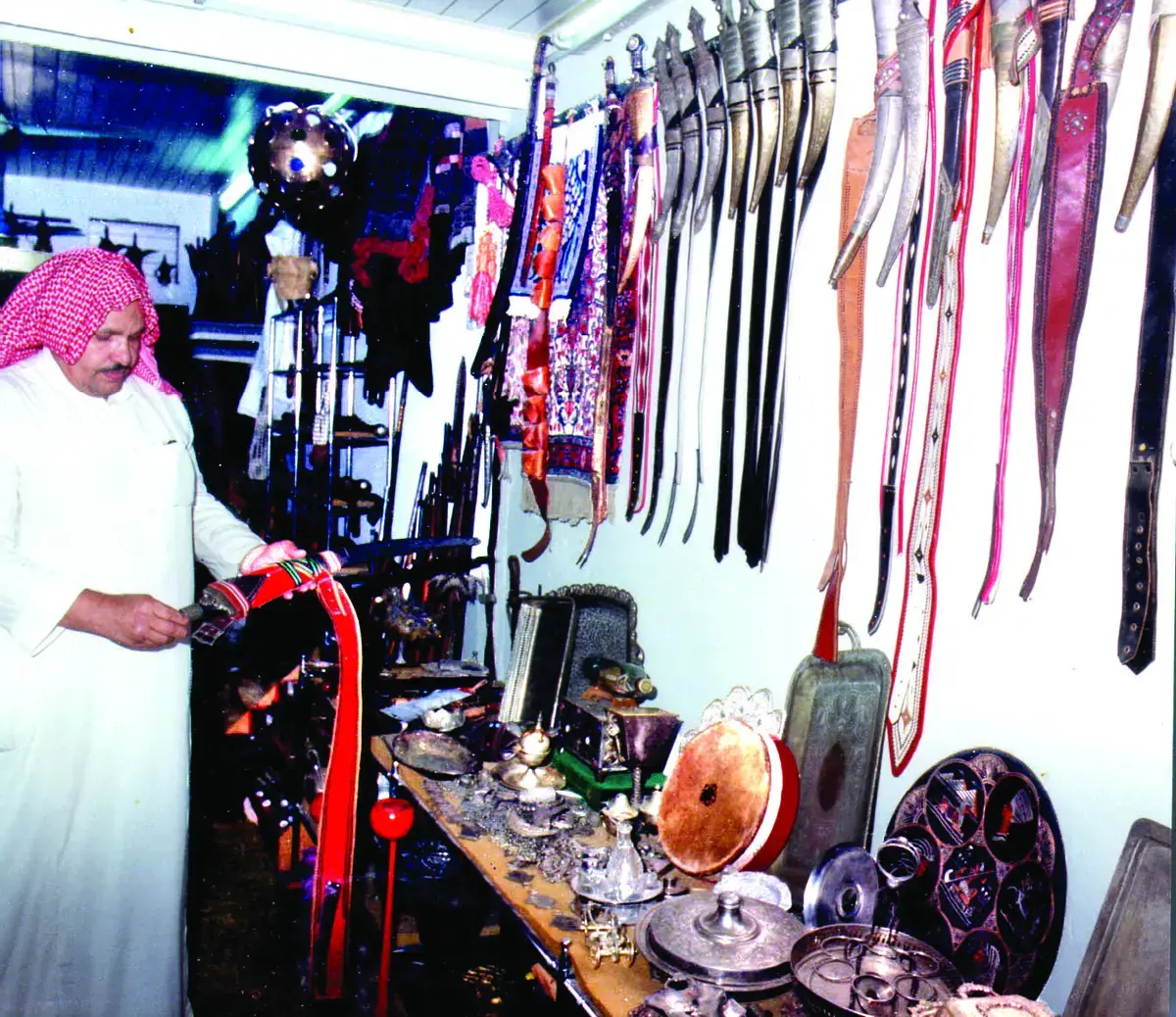
Each region had special designs that distinguished it, represented by the drawings and engravings with which these products were embroidered. Asir has been known since ancient times for some different industries, including - blacksmithing - beadwork - wickerwork (dum fronds) - wood carving - tanning - weaving - traditional weapons manufacturing - metal casting (ornaments and jewellery), and other various crafts.

Asir was also famous for its metallurgical

06

Asir was also famous for its metallurgical industries, which included extracting gold and silver from the ground and using them in jewelry, embroidering clothes, and inlaying daggers, swords, and guns. It was also known for extracting iron from which the necessary pieces for doors, windows, and agricultural tools were made.

There is one or more blacksmiths in every village, and some of the blacksmiths practiced their work moving with their tools from one place to another.

The residents of Asir were famous for

07

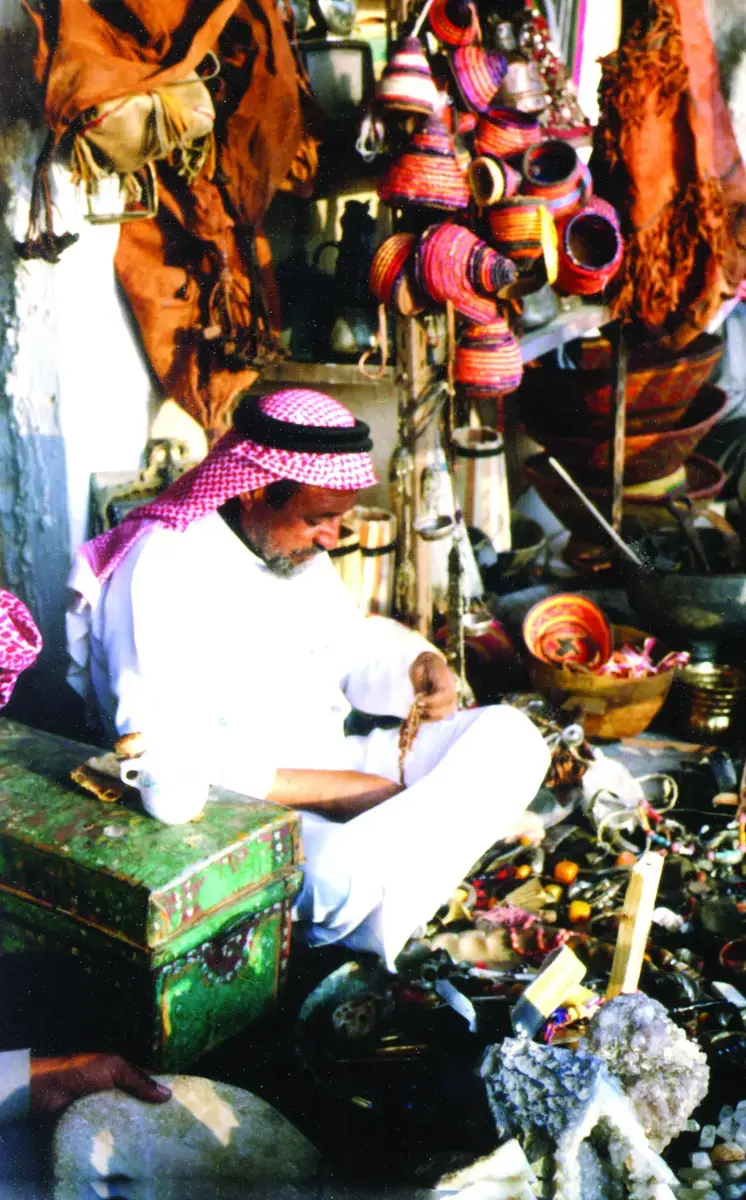
The residents of Asir were famous for spinning sheep and camel wool and making clothes. There were some handicrafts practiced by women who used straw derived from palm leaves and dum to make mats, hats, etc. There was also a copper industry known to the people until recently, as household utensils were made from this metal.

Some craftsmen would paint copper utensils with tin at least once a year, and some of them would make utensils from pottery or from a special type of stone.

There are many traditional industries and handicrafts

08

There are many traditional industries and handicrafts in the Asir Region, some of which are still practiced today, and which do not depend on machinery, but rather depend on the human hand for the purpose of securing the needs of the people in their simple lives. These industries depend primarily on the raw materials available in the environment itself, such as wood, red clay soil, some types of leather, and wool taken from sheep and camel hair.

Let us learn about some of the

09

Let us learn about some of the industries and handicrafts in the past in the Asir Region, which were practiced by people who inherited them from their fathers and grandfathers, and even Asha Abha was given the title of these crafts.

Wood industries

Carpentry and carpenters are two names that

10

Carpentry and carpenters are two names that met each other a long time ago and met the needs of society at all stages it went through according to their professional ability, despite the multiplicity of society’s demands, which are necessary demands and are even considered living demands that include all aspects of life, and they are: Doors and windows: They are made of hard wood that can withstand natural conditions and factors such as ash, juniper, and acacia.

The latch or latch: It is used to lock doors in the past.

The parts of the latch consist of

11

The parts of the latch consist of entrances and a channel. The device, the blame, and the bandage: all of them combined are the components of the plow that is placed on bulls to plow farms. Al-Madasam: It is used to level the land after plowing it, planting it with seeds, and leveling the grains after scattering them. It consists of a long stick of wood approximately three meters long, and its end is a piece of wood in the shape of a triangle used for leveling.

The bicycle

12

The bicycle: It is the one that is under the Mahalla in the Mishnah as soon as the bucket or west rises from the albir. The wheel: It is made of wood assembled in the form of triangles to form a circle with a cavity inside it through which the rope ((Al-Rasha)) passes, which carries the west from Al-Bir to Al-Mishna, carrying water to irrigate the farms. The Iraqi: It is in the form of a plus sign in the bucket and is made of wood.

There are two types of Iraqi, the Falah’s Iraqi and the Ibn al-Badiya’s Iraqi.

The Falah’s Iraqi is connected with ropes

13

The Falah’s Iraqi is connected with ropes, and the Ibn al-Badiya’s Iraqi is more perforated and connected to belts. Al-Majnab: It is made of wood and is used by farmers to farm the countryside. Sahafa: It is a bowl used to place food in and it is considered like a plate, but it is made of wood. There are multiple sizes of newspapers. There are small ones that are served to the family, and there are large ones that are served to guests.

The sahafa is made of tamarisk wood, as well as Sidr. When they are large, they are connected together with glue.

The glue is obtained from some trees

14

The glue is obtained from some trees and colored with tar. The tar closes the small holes that were not closed by the glue and gives a specific color. It also protects the utensils from scratches while carrying them from one place to another. Paint it with tar on the outside only. Cup or mug: It is made of wood in the shape of a bowl or bowl. It has a side handle and comes in different sizes. It is used to put broth, ghee and milk in it.

Masawat: It is a piece of wood in a circular shape, half a meter long. It is used to stir porridge, pastries, etc.

The mastawat is made of wood and

15

The mastawat is made of wood and is characterized by the fact that it does not leave any taste in the food. Measures: These are the ones used to measure grains, and there are many types, including the sa’ ((madd)), the quarter, and the eighth. They are made of wood by carving a thick stem of wood, and they are provided with handles made of metal rings.

In addition to what was mentioned, there are many other industries, such as wooden carpentry and handles for agricultural machinery such as mowers, axes, mowers, and others.

Walker

16

Walker: It is made to help young children teach walking. It is a tool that rests on wooden wheels at the bottom. Spindle: It is used in spinning wool and wool. Al-Sarraj: Derived from the word siraj, it is a piece of wood in the shape of a rectangle with two lower and upper bases, to the top of which is tied a burning stick that gives light to those sitting. The sihara is a box made of wood decorated with engravings and drawings.

It is essential for every home, where documents, jewelry, and valuables are placed.

Iron industries

The blacksmith profession is an ancient profession

17

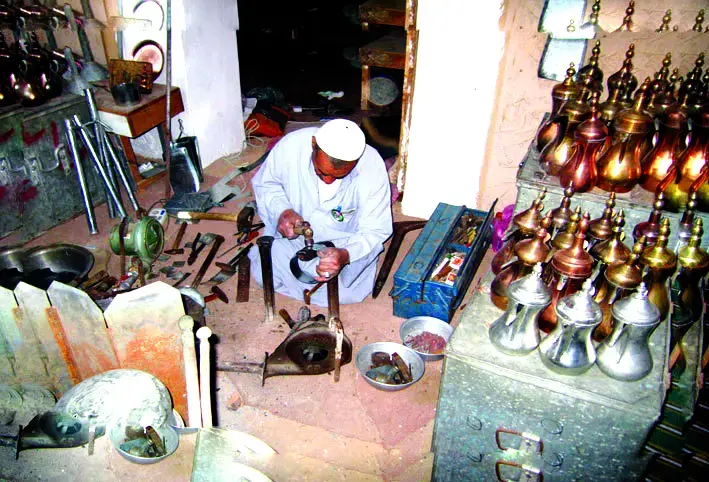
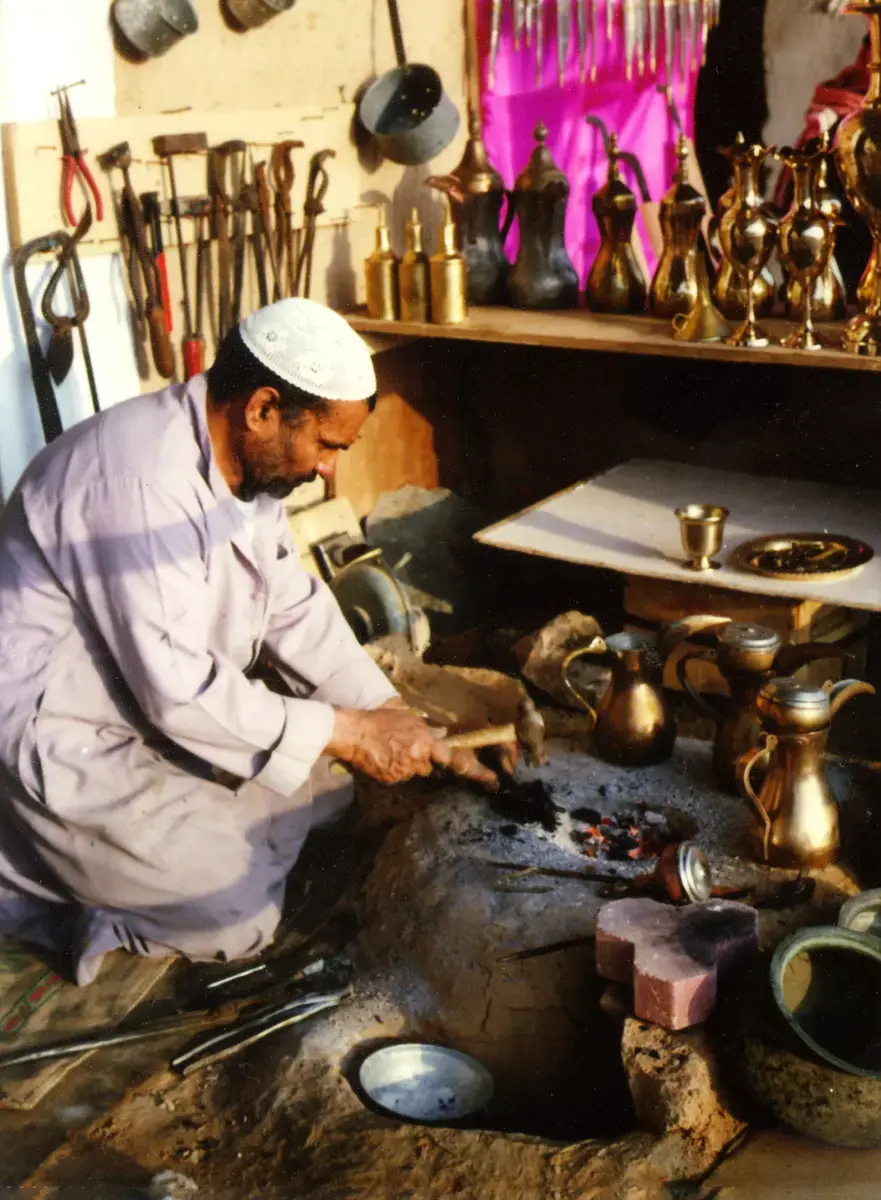
The blacksmith profession is an ancient profession that requires an art in engineering the required shape and an art in processing iron, using tools and equipment consisting of a kiln (forging), a limestone, a bellows, an anvil, tongs, and hammers of various sizes and shapes depending on the metal to be forged. Raw iron is brought and placed in the furnace (forging) and heated until it melts and the slag and impurities come out of it.

Then the pure iron is taken out in pieces and then holding the piece to be formed.

Using tongs, place it in the oven

18

Using tongs, place it in the oven until it browns, then knock it over the anvil and shape it according to need or the desired design. In a past time, before the unification of the kingdom and its inhabitants enjoying security and safety, fear was the companion of the path, and insecurity about the soul and the precious resided in the hearts and nested within them.

In light of the lack of security

19

In light of the lack of security and security, our forefathers had no choice but to acquire weapons of all kinds, such as rifles, swords, swords, spears, spears, knives, swords, and daggers, as a source of security. In ancient times, the man did not walk without drawing his weapon for self-defense and to restrain people.

The strength of those who lurked in the tribe, and whoever possessed the most and the best weapons would brag about them to others, and these weapons would be hung on the chests of the councils for the sake of pride and pride.

The profession of weapon making required effort

20

The profession of weapon making required effort, patience, and strength, as it used primitive tools. There were two types of rifles ((the fuse gun and the suppressor rifle)) and they were made in a very simplified way. An iron pipe was brought in, the beginning of which was narrower than its end, the end was tightly locked, and one of its sides was pierced.

Then it was given to the carpenter

21

Then it was given to the carpenter to make the woodwork, where the pipe was placed in the middle of the wood that surrounded it, then the trigger was installed, and then it was inlaid with silver in some of its parts, such as its front and around the trigger. As for the white weapons, they were made of iron, the finest, useful type. The tools and equipment used were the anvil, hammer, and fire.

The craftsman used firewood to complete his work, and the best quality wood was wood, as his fire remained burning for a long time.

After he put the iron on the

22

After he put the iron on the fire, he hammered it manually until it came out of the shape he wanted, whether it was a sword, dagger, side, or old. Then he made the handle from animal horns and fed it. In gold or silver, the same applies to the scabbard. The outside is made of iron and the inside is made of wood and covered with gold or silver. The other steel industries are: Dalal and strainers: This is the famous Arab Dalla for coffee.

As for the strainer, it is of

23

As for the strainer, it is of the same type, but it is distinguished by the fact that it is made of copper and always shines. It is called the strainer because they put the coffee in it after it has finished making it, and they put pieces of fiber in its neck to trap the cardamom when pouring it into the cup. Pots: They were made of copper. The lamp or lamp: It is a hollow piece of iron in which gas is placed and has a cover.

From it emerges a wick that is ignited in the evening, emitting a light that illuminates the rooms.

Surveying

24

Surveying: which is used for digging and leveling in agricultural lands. Tent pegs: used to stabilize tents Aljzah: To place the fire, the cups that are used for fire, and the atifah, which is the small ax and axes. Boats and stoves: which were used in ancient times to cook food. Drag: The iron plow pulled by cows to plow the land. Al-Majnab: Farmers use it to cross-cut the country and it is also made of wood.

Claw: It resembles a pick, but it is serrated and is used for harvesting clover and grass.

Al-Sharim or Al-Mahsh

25

Al-Sharim or Al-Mahsh: It is used to cut herbs from the stems. It has two sides and cuts the plant back and forth.

Leather industries

The leather and beadwork industry is one

26

The leather and beadwork industry is one of the oldest archaeological industries, the most important of which are: Knife and Janabi sheaths: They are made in different sizes and are used for decoration, parties, and events, and they are still used today. Decorated belts: with which the jambiya, dagger, and sabbath are worn. Ayyab: It is the plural of defect. This is used to preserve food during travel, where it is placed on camels. Sunset: plural (gharb).

It is used to bring water from wells using bulls and camel drivers.

Water Bucket

27

Water Bucket: It is made of leather to bring water from the well. Al-Qataf: It is used to preserve coffee. Nasa: Plural of (nasa) and made of leather, which is what is used to tighten camels to tie up luggage. The bag: which a woman uses to carry and store water. Akkah: It is made from the skin of young goats to preserve ghee or honey. Shakwa: It is a special leather container used to churn milk and turn it into yoghurt and butter.

Al-Kharj: It is one of the beautiful primitive industries that have expressive shapes and engravings that attract attention.

The Kharj is usually made to be

28

The Kharj is usually made to be placed on the back of an animal or a mount, and from it hang saddlebags made of the same fabric and colors that end in hamlets that hang about a meter below the belly of the mount, called safaya. Women use the saddlebag to store decorative tools, especially those used on a daily basis such as kohl, soap, etc. The saddlebag is hung on the (middle) column of the house. The shepherd also uses it to store food and some food.

Types of food related to it or sheep.

Pouch

29

Pouch: A leather bag in which men keep their personal items while traveling, such as money and coffee. Al-Mezba: A small leather cradle in which children are placed to make it easier to carry them during travel. It is decorated with engravings and small leather fringes hang from it for decoration. The equipped one: It is larger than the saddlebag and is placed on the back of the mount.

The traveler may have one or two with him, and their colors are bright, with which he carries his provisions and luggage.

pottery

Pottery making is one of the crafts

30

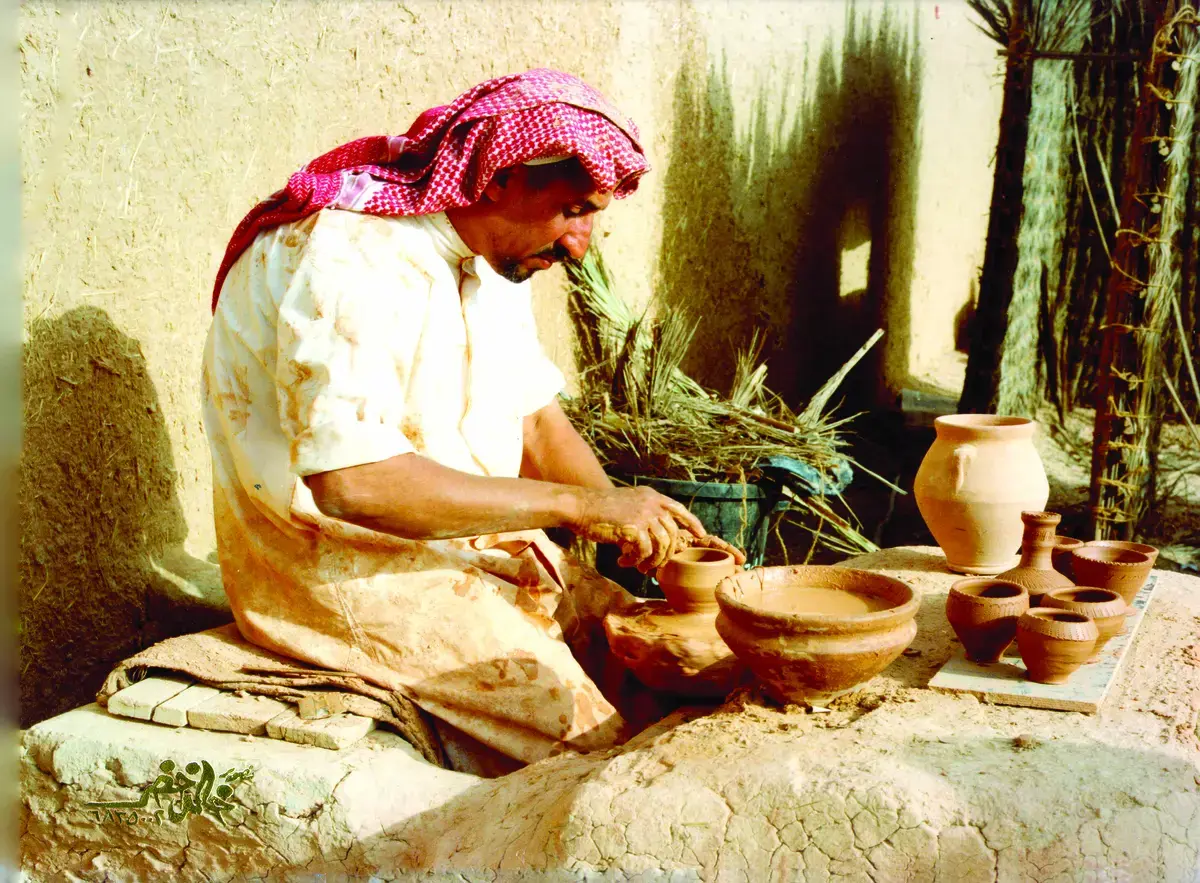
Pottery making is one of the crafts that has been known since ancient times and is used in making utensils. The most famous of them are: Cup or zeer: which is used to preserve and cool water. Al-Jazza or clay: Al-Jazza is a model made of pottery, clay, or cement with beautiful engravings that take on the character of the environment in Asir.

Inside it there is charcoal (fire) where coffee pots and teapots are placed in a distinctive way, and this appearance is still found in most homes in the Asir region. Tandoor (miva): It is used to make bread.

Wood is placed inside it and set

31

Wood is placed inside it and set on fire until it turns into embers, then dough is stuck to its walls until it is cooked by the heat of the embers. Burma: A spherical vessel with a small hole in the top, used for cooking meat and preserving fat. Al-Ghadhar: It is a pottery vessel in which the broth is placed. Burners and incense burners: used for incense. In addition to many things of aesthetic and heritage forms and many things that are Asir to enumerate.

The tools that are made of solid rocks are: Mill: It is used to grind grains.

Crushing

32

Crushing: It is used to crush women's perfume. The professions of parents and grandparents in the past are many and varied and affected their daily lives at that time, and these are among these industries. Plaster industry: Rope making: twisting and re-twisting ropes, and making ropes from rape and palm fibers was one of these professions that men practiced at that time and until recently, and this profession is very tiring for the hand, arm, back, and neck.

Women's handicrafts

The woman worked in the professional sector

33

The woman worked in the professional sector in addition to regular household chores, such as cleaning the house, grinding grains, cooking food, crushing grains and preparing them, cleaning her clothes and her husband’s clothes, bringing water to the house on her head, and fetching firewood sometimes.

In addition to that, she assisted her

34

In addition to that, she assisted her husband with the work that suited her from the work of her husband’s profession, whether that was in making the necessary equipment for beauty, cutting wood with carpentry, polishing utensils with the blacksmith, and she even used to blow forges with the goldsmith and blacksmith, and prepare

She uses leather for beading, in addition to the professions that she performs herself, such as knitting, making wicker products, sewing, embroidery, etc.

She is an active working member in

35

She is an active working member in that society from the break of dawn until after the last evening prayer. She works like a bee, and she has extracted the scope of her service from the environment and her needs so that she contributes to achieving self-sufficiency for her community, as she employs everything that falls into her hands for the demands of her daily life. This work produced the most beautiful handicraft products that no home can do without.

The handicraft products were displayed in a

36

The handicraft products were displayed in a popular market that the people of the neighboring villages and the desert came to buy and sell. Among these markets were special shops and corners for women where they supervised them. Women at that time competed to make these handicrafts and master them. There was cooperation from everyone to produce popular handicrafts. Wicker making was also one of the professions that women worked in.

Among the most important of these products were: Jabab: It is a type of men's clothing.

It is made of wool and is

37

It is made of wool and is woven by women in different colors. It is heavy in weight and is characterized by its ability to be used for many years. Madarat: It is the plural of madarat. It is women’s clothing and is also made of wool. It is somewhat similar to men’s robes. Hair houses: Women excelled at weaving and making hair houses and were able to weave them perfectly, and they are also made of wool.

Brooms: They are made from palm fronds, and there are other types made from palm fibres.

Slings

38

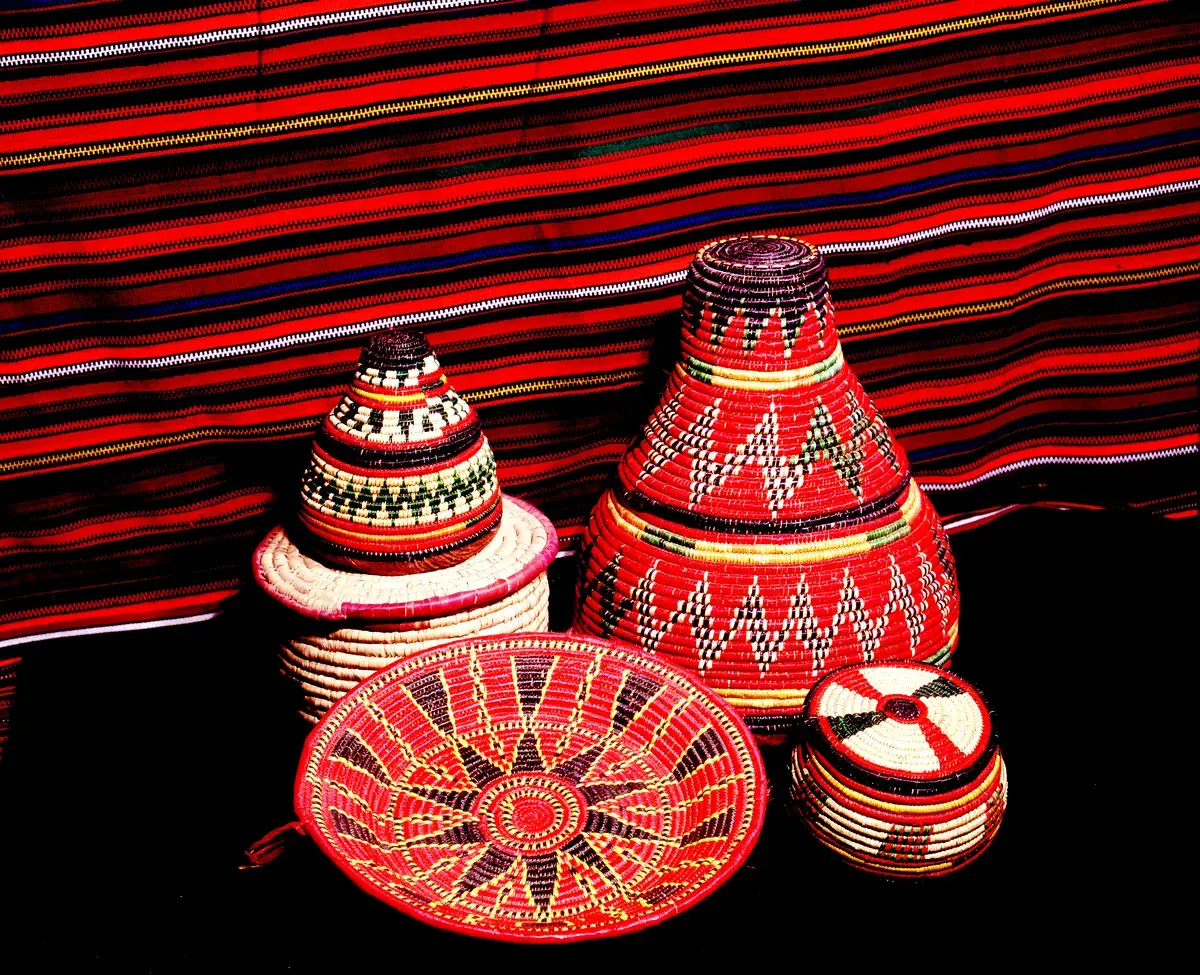
Slings: There are many types, varying in size and type of wicker, and they are used for transportation and storage. Al-Qataf: It is a sac-shaped bowl of wool with wickers hanging from it. It is used to place coffee and cardamom. Khasf: It is used for packing grains, dates, and other uses. Gouna: It is a container used to store bread.

Al-Waqf: in which small quantities of grains are stored or what is given as a gift when exchanging visits between family, relatives and friends.

Women also make household items made of

39

Women also make household items made of wicker and palm leaves, such as: Traveling plates - a protractor - mats - a fan (called a mahfa) - a hanger. They also make ropes in which women rely on goat and sheep hair, which is cut and wet with a little water, then purified and spun until it becomes twisted threads, then braided and braided in the form of ropes. Ropes are also made from a material extracted from Tihama called salb.

Category: عسير
Previous Back to index Next