
Culture and literature
Previous Next Back to index العربية
Culture and literature

Culture and literature

Culture is the first engine of renaissance, and the main factor for the progress and advancement of society,

Culture is the first engine of renaissance, and the main factor for the progress and advancement of society, and it is the main axis in pumping and supplying the channels of the nation’s renaissance project in order to reach a society in which the values of culture, science and knowledge prevail.

Cultural activity has developed greatly within the framework of the comprehensive development of life in the region, by benefiting from the rich cultural reserve available in the local popular memory and from the data of modern Arab Islamic culture, which the prosperous Saudi era encouraged to take full advantage of in order to build man and the nation constructively.

4Sections
6Images
22979Characters
عسيرCategory
Culture and literatureThe story of the first literary club in Asir in 1355 AHAbha Literary ClubThe first newspaper in Asir about a century ago: “Al-Asir” newspaper
Culture and literature
Culture and literature - 1
Culture and literature
Culture and literature - 2
Culture and literature
Culture and literature - 3
Culture and literature
Culture and literature - 4
Culture and literature
Culture and literature - 5

Culture and literature

Culture is the first engine of renaissance

01

Culture is the first engine of renaissance, and the main factor for the progress and advancement of society, and it is the main axis in pumping and supplying the channels of the nation’s renaissance project in order to reach a society in which the values of culture, science and knowledge prevail.

Cultural activity has developed greatly within the

02

Cultural activity has developed greatly within the framework of the comprehensive development of life in the region, by benefiting from the rich cultural reserve available in the local popular memory and from the data of modern Arab Islamic culture, which the prosperous Saudi era encouraged to take full advantage of in order to build man and the nation constructively.

Healthy and strong, the interest in cultural

03

Healthy and strong, the interest in cultural and heritage life was no less than in others, as there were great achievements in this field, such as clubs, literary and cultural centers, the King Fahd Cultural Center, the Al-Muftahah Fine Arts Village, and the branch of the Saudi Arabian Society for Culture and Arts in

Abha, which participates in cultural and artistic activities in the region through its committees specialized in cultural affairs, theatrical affairs, folk arts, heritage, music, singing, media, publishing and artistic direction, the Shada Palace Archaeological Museum, and popular museums.

The other, which focused on all types

04

The other, which focused on all types of cultural and intellectual activities through periodic and non-periodical publications, exhibitions, seminars, literary evenings, and cultural dialogue meetings, and paying attention to young artistic and literary talents and providing them with the opportunity to take off, while supporting intellectuals and creative artists from the people of the region to exercise their actual role in society.

The annual Abha Cultural Award, sponsored by

05

The annual Abha Cultural Award, sponsored by His Royal Highness Prince Turki bin Talal, Emir of Asir Region, and organized by the Literary Club in Abha, is considered one of the most important cultural activities in the Kingdom, the Arabian Gulf region, and the Arab region, and its various activities are accompanied by a wonderful festive atmosphere.

Advanced steps were achieved for the media, and the Abha TV Center was established, which produced many distinguished media programmes.

In addition to the TV transmission center

06

In addition to the TV transmission center in Abha, there are other centers in Jabal Nahran, Dahran Al Janub, Bishah, Al Namas, and Sabt Al-Alayya, and television rebroadcast centers in Al-Soudah and Jabal Qarah, in addition to a Taqwa radio station, a branch of publications management, an office for the Saudi Press Agency, a media center, and branches of all daily newspapers published in the Kingdom.

The Asir Foundation for Press and Publishing publishes a newspaper.

An advanced daily newspaper (Al-Watan), which is

07

An advanced daily newspaper (Al-Watan), which is published on an international level and uses the latest modern technology in the field of the media industry to keep pace with the development that our country is witnessing in this vital and important field. Sports have witnessed great development with the establishment of sports stadiums and indoor halls, support of clubs, and organization of local, regional and international sports tournaments.

Despite the mixing of tribes with each

08

Despite the mixing of tribes with each other as a result of the great urban expansion, the spread of education, and the multiplicity of economic activities, and its transformation into one homogeneous society that includes harmony and solidarity and enjoys the security, stability, and prosperity that Saudi society experiences under its wise government, the most beautiful thing about Asir

Region is that it still preserves and adheres to those beautiful authentic customs and traditions, even if their patterns and forms have changed to suit the new social and civilizational conditions.

The story of the first literary club in Asir in 1355 AH

The writer friend

09

The writer friend: Muhammad bin Abdullah Al-Hamid (may God have mercy on him), in his weekly column in Al-Watan newspaper (Sunday, Rabi’ al-Awwal 25, 1435 AH, corresponding to January 26, 2014 AD), mentioned the text of the historical document about the founding of the first literary club in Abha, which he mentioned was in the possession of Professor Ghazi Badawi (may God have mercy on him).

Despite the novelty of its scientific material

10

Despite the novelty of its scientific material, a researcher might be embarrassed to study it in a daily newspaper without paying attention to its original manuscript and verifying it, were it not for the literary confidence enjoyed by the eminent writer, as I saw no harm in capturing its text here, such as (The Snapshot of Al-Ajlan), as it is of great importance, otherwise its place would be in the book: The Origins of Contemporary Saudi Literature in the

South of the Kingdom of Saudi Arabia (1352 - 1380 AH) on the day it was printed and published if It was reprinted, when it was not included in it on the day of its publication in its first or second edition, and this is an issue that researchers know and do not regret its loss.

Professor Muhammad Al-Hamid says in his aforementioned

11

Professor Muhammad Al-Hamid says in his aforementioned article, pleased with his elegance: “I found a historical document kept by Brother Ghazi Badawi Al-Asiri, a resident of Jeddah Al-Mahrousa, proving the establishment of the first literary club of its kind in Abha.” He added to that his saying: “Abha was distinguished by its square-shaped market at that time, in the middle of which was the municipality, and the Barzan

Mosque, next to which was the emirate and the police, and along it was Ras Al-Malah, and the Grand Mosque to the west; The People's Seas Square, the Finance Building, and the Princely School, and behind it were the infirmary and the military barracks.

In their free time, people would go

12

In their free time, people would go to the shops of some notables, where they would discuss the news of society and those arriving from travel, and later the news of the world they heard on the radio in its first days. If the weather was suitable, they would hold their seminars, either in those shops in the early morning hours or in the afternoon, and they would discuss anecdotes and anecdotes that would resonate for a period of beautiful time.

All of these are useful and rare.

I said

13

I said: If I had been informed of this document before, I would have been one of the lucky ones with a distinguished scientific background. Someone like me rejoices in what serves his field of study and his field of specialization, especially what is hidden from many researchers about the thought of the people of Asir, the home of my precise specialty.

Whatever the case, Al-Hamid says in another part of his column

14

Whatever the case, Al-Hamid says in another part of his column: “The text of the document that gives contemporary generations a picture of their ancestors’ ambitions and literary aspirations was completed at a very early time. It coincides with the founding and unification of the Kingdom at the hands of King Abdulaziz and his aides from all over the country, and confirms the glorious primacy of Abha in waging literary battles.

Perhaps the future will reveal to us

15

Perhaps the future will reveal to us other folded pages of the landmarks of the renaissance.” The veteran writer of intelligence and distinguished intellectual presence (may God have mercy on him) believed it. The text: The Asiri Literary Club, which opened on Monday night at 2:30 a.m. from 3/15/24/1355 AH at the house of Muhammad bin Dhawi. The club’s members consist of: • Professor: Muhammad bin Dhawi. • The literary professor: Mr. Ahmed Obaid.

• The literary professor: Suleiman Rajab. • Professor: Talaat Wafa.

• The literary professor

16

• The literary professor: Muhammad Al-Bassam.

The opening was attended by the rising

17

The opening was attended by the rising generation of students for whom the club was founded, and they are all of the following young men: • Abdullah bin Ali bin Humaid • Abdullah bin Abdul Rahman Elias • Saeed bin Misbil • Abdullah Al-Zamili bin Khadra • Ahmed Haider • Saeed Muhammad Al-Ghamaz • Sharif Abdul Rahman Al Hazmi • Abdullah bin Mutaq • Abdullah Ali bin Misfer • Hammoud Badawi • Ali bin Muhammad Al-Mughidi • Suleiman bin Hassan Memish • Ahmed Abu Halil •

Abdullah bin Khanfour These young men are graduates of the Rashidi School during the era of

the Ottoman Empire, and we wish them

18

the Ottoman Empire, and we wish them success in their literary career.” I said: This text indicates a not-so-distant historical precedent related to the year 1355 AH, the beginning of the establishment of formal education in Asir, as it is surrounded by the names of prominent figures with a clear literary and scientific presence, and with them a generation of the first Asir youth who lived after the culture in those parts of the Kingdom of Saudi Arabia.

In this text there is also a

19

In this text there is also a mention of the Al-Rashidiya School, which I think does not include in this document all those who studied in it.

This document carries the utmost intellectual, literary

20

This document carries the utmost intellectual, literary, and historical importance, as it preserved the history of literature in Asir with a pioneering temporal precedence, as it identified the year 1355 AH, as the starting point for the awareness of those first generation in the

Asir region, about their various literary and functional homes, when they made someone’s house the headquarters of that club, and identified its members, so that those familiar with the literary and intellectual movement in the Kingdom of Saudi Arabia would know from afar, the role of those pioneers in spreading culture at that time.

One of the advantages of this literary

21

One of the advantages of this literary formation was that it included in its system a number of early enthusiastic young men, who graduated from the Rashidiya school that emerged during the era of the Ottoman Mutasarrifid, and all who contributed to building the literary and cultural life in the Asir Region.

I remember knowing the men of the

22

I remember knowing the men of the latter since I began writing about the history of literature in Asir in the late tenth decade of the fourteenth century AH, and the day I settled there, since I moved to Abha in 1404 AH, as that was my last career move.

Then the state of culture, literature, and

23

Then the state of culture, literature, and Asir grew since the founding of this club, and when formal education arose, around the years 1354-1355 AH, and the growth of this intellectual reality increased after that, when its prince promoted the movement of thought and literature in the Asir region through his famous literary and intellectual council, and through the cultural forum that he called for every year, and through the annual scene of the Abha Prize for

Culture, not to mention the establishment of: the Abha Literary Club, and the establishment of the King’s University.

Khaled, Al-Watan newspaper, and the connection between

24

Khaled, Al-Watan newspaper, and the connection between the countries of Tihama and Asir through its giant projects, and even the growth of the causes of contemporary civilization witnessed in the Asir region after that.

And what was said is not limited

25

And what was said is not limited to the importance of this document only, but its mention extends to the same weekly column that announced this document when its writer (may God have mercy on him) mentioned the topography of the city of Abha at that time, and referred to its mosque, its popular market, its municipality, its emirate, and the police.

And the finance building, primary health care

26

And the finance building, primary health care, and the old military barracks that researchers and scribes mention in their historical monuments, not to mention his description of the aspects of local life represented by the merchant class and their role in attracting people to hold their local councils within the confines of their shops in the morning and evening, while they listened to the news of shoppers and what was carried on the air via the radio, their only media tool at that time.

All those who gave this hadith appropriate scientific importance may be useful in building the literary and cultural life in the Asir Region in its history.

Abha Literary Club

Many men of thought and education and

27

Many men of thought and education and those interested in the literary movement and intellectuals in the region called for the establishment of a literary club and held successive meetings to explain the club’s goals listed in the list. The club’s idea and goals were conveyed to the various classes of society.

Its president and members also made field trips for this purpose, and the result of this was the registration of a large number of those interested in the literary movement and intellectuals in the region as active and affiliated members.

In response to the hopes and aspirations

28

In response to the hopes and aspirations of intellectuals, literary masters, and educated youth in the region, the approval of His Highness Prince Faisal bin Fahd, General President of Youth Welfare, was issued for the establishment of (Abha Literary Club) in the middle of the year 1398 AH, and it was opened in the year 1400 AH, then it was annexed to the General Agency for Cultural Affairs in the Ministry of Culture and Information.

The Abha Literary Club was able to

29

The Abha Literary Club was able to contribute to serving literature and writers, and spreading awareness and culture, in the Asir Region as a whole, from its founding until now, and contributed to the expansion of the cultural base in the region, due to its abundance of creative talents in various fields of creativity and culture.

It was a fulfillment of the hopes

30

It was a fulfillment of the hopes and aspirations of the pioneers and masters of thought and pen with whom the region abounds, and the club has enjoyed the efforts of the most prominent writers and historians of the Asir Region since its establishment in the year 1400 AH.

- Founding members in 1398 AH -

31

- Founding members in 1398 AH - Abdullah bin Ali bin Humaid (may God have mercy on him) - Muhammad bin Abdullah Al-Hamid - Ahmed bin Ibrahim Mataan - Mahdi bin Ibrahim Al-Raqidi - Abdel Muti Mani Ayed - Hashim bin Saeed Al-Naami - Muhammad bin Ibrahim Al-Naami - Hussein bin Dhafer Al-Ashwal - Ali bin Ahmed Al Omar Asiri - Ali Al-Hassan Al-Hafzi - Ali Muhammad Alwan (may God have mercy on him) - Yahya Hassan Al Ayed - Ahmed Muhammad Al-Turabi

The first board of directors was formed, headed by Sheikh (Abdullah bin Ali bin Humaid), but death befell him, may God have mercy on him, at the beginning of the year 1399 AH, before arrangements for the opening were completed.

The Board of Directors was reconstituted in late 1399 AH as follows

32

The Board of Directors was reconstituted in late 1399 AH as follows: 1 - Muhammad bin Abdullah Al-Humaid, President 2- Ahmed bin Ibrahim Mataan, Vice-President 3 - Mahdi bin Ibrahim Al-Raqidi, secretary 4 5 - Hashim bin Saeed Al Nuami, member - Abdel Muti Mani Ayed, Treasurer 6 - Muhammad bin Ibrahim Al-Naami, member 7 - Hussein bin Dhafer Al-Ashwal, member 8 - Ali bin Ahmed Al Omar Asir, member After that, Mr.

Ali bin Al-Hassan Al-Hafzi joined the Board of Directors as a replacement for Mr.

Mahdi Ibrahim Al-Raqidi, who resigned due to

33

Mahdi Ibrahim Al-Raqidi, who resigned due to his working conditions. The Board of Directors was formed after some members resigned due to their own circumstances: Mohammed bin Abdullah Al-Humaid, President D. Abdullah bin Muhammad Abu Dahesh, Vice President Muhammad Abdel Rahman Al-Hafzi, Secretary Ibrahim Muhammad Al-Louth, Treasurer Hussein bin Dhafer Al-Ashwal, member D.

Ali Saad Al Musa, member Ahmed Abdullah

34

Ali Saad Al Musa, member Ahmed Abdullah Asiri, member On 2/4/1410 AH, the new club headquarters was officially opened under the patronage of Prince Khaled Al-Faisal, Emir of Asir Region, and in the presence of a large crowd of guests of the first Abha Cultural Forum.

The headquarters includes offices for each of

35

The headquarters includes offices for each of the (President - Vice President - Financial Affairs - Meeting Hall - Platform Activity Committee - Secretariat - Administration Office - Library - Abha Culture Award Secretariat - Audio and Visual Library - Printing and Publishing Committee Office - Relations and Media Office - King Fahd Lecture Hall - Al Khansaa Lecture Hall) in addition to public facilities, housing, gardens surrounding the club, and parking.

The last formation of the Board of Directors was after the resignation of Mr.

Ahmed Abdullah Asiri in the month of

36

Ahmed Abdullah Asiri in the month of Shaban 1424 AH, and he was replaced by Mr. Ahmed Al-Tihani, and it remains until now: Mohammed bin Abdullah Al-Humaid, President D. Abdullah bin Muhammad Abu Dahesh, Vice President Muhammad Abdel Rahman Al-Hafzi, Secretary Ibrahim Muhammad Al-Louth, Treasurer Hussein bin Dhafer Al-Ashwal, member D. Ali Saad Al Musa, member Ahmed Abdullah Al-Tihani, appointed member The club's board of directors was headed by Mr.

Muhammad Abdullah Al-Hamid, then Mr. Muhammad Zayed Al-Almai, then Mr. Anwar Khalil, then Dr.

Ahmed Al-Murai. The club holds many pulpit

37

Ahmed Al-Murai. The club holds many pulpit events, cultural and literary lectures and seminars, and publishes and issues books, magazines and cultural periodicals, in addition to its sponsorship of cultural and creative weeks such as Mawhibah Week. The club holds poetry and story evenings in the Asir Region governorates.

Club committees History and Heritage Committee Poetry

38

Club committees History and Heritage Committee Poetry Committee Story committee Literary Criticism Committee Public Relations and Media Committee Printing and Publishing Committee Platform Activity Committee Technical Committee Pioneers Committee.

Club achievements The club worked to fill

39

Club achievements The club worked to fill the void before the opening of the branch of the Saudi Arabian Society for Culture and Arts in Abha by encouraging visual artists, reviving popular heritage, collecting some ancient antiquities, and holding Eid celebrations and evenings during the summer season in the public square in Abha.

Among his successful experiences was his calling

40

Among his successful experiences was his calling and holding intensive meetings for a number of officials from the Department of Tourism Development in the Emirate of Asir Region, the Municipality of Abha, the Youth Welfare Office, the Culture and Arts Association branch, the Ministry of Planning branch, and the Abha TV station at the beginning of the summer under the name (Summer Activities Coordination Committee).

The result was that the idea was

41

The result was that the idea was adopted by the officials, led by the Emir of the region, and it was developed under the name (Tourism Activation Committee) and an integrated cultural and sports program was prepared and its paragraphs were successively implemented and was appreciated by citizens, residents and vacationers. Both, and the club is still an active member of the Tourism Activation Committee in Asir Region, which was the result of those beginnings.

- He introduced a number of young

42

- He introduced a number of young writers to the literary community in the field of poetry, stories, research, and public speaking through various means, including publishing the collection “Poems from the Mountain,” which included six young poets, more than thirty poems, and a short story collection, “Threshing floor of the text,” for a large number of narrative groups.

The club management was keen to transmit

43

The club management was keen to transmit a number of club events to young people in their colleges, institutes and clubs, whether in Abha or other major cities in the region, such as Khamis Mushait, Bishah, Muhayil, Al Majardah, Tanomah, Al Namas, Al-Qunfudhah, Bish, Sarat Abidah, Dhahran Al Janub, Al Birk, Rijal Almaa and Balqarn, with a desire to spread the benefit and confirm the connections and connections between the people of the same region.

He completed (37) cultural competitions in short stories, essays, historical research, children’s literature, memorizing and reciting the Holy Qur’an, the noble Prophet’s hadith, and the library. Encouragement prizes were allocated to the winners, and the turnout for them was good and the desired results were achieved.

Until the year 1416 AH, the club completed twenty-six cultural competitions that included short stories, essays, historical and literary research, children’s literature, memorizing and reciting the Holy Qur’an, as well as the noble hadith, and allocating incentive prizes to the winners. The club received many delegations of students, whether schools or universities, from all regions of the Kingdom, where they visited the club and viewed its library, and were presented with collections of the club’s publications.

The club held ten book fairs in

44

The club held ten book fairs in the Asir Region until the year 1417 AH, in partnership with the branches of King Saud University and the Imam Muhammad bin Saud University in Abha, and most of the schools, universities, literary clubs, the Society for Culture and Arts, and the King’s Library participated in it. Abdulaziz, and the King Faisal Center for Research and Islamic Studies.

He established a library containing various types of knowledge, including religious, historical, literary and scientific knowledge, and it now includes more than 25,000 books.

In the year 1421 AH, King Abdullah

45

In the year 1421 AH, King Abdullah bin Abdulaziz Library was built in an independent building with the generous support of His Royal Highness Prince Abdullah bin Abdulaziz, Crown Prince, Deputy Council of Ministers, and Head of the National Guard.

One of the club's most notable achievements

46

One of the club's most notable achievements is that it held intensive meetings with a number of officials from the Tourism Development Department in the Emirate of Asir Region, the Abha Municipality, Youth Welfare, the Culture and Arts Association branch, the Ministry of Planning branch, and the Abha TV station at the beginning of the summer.

Due to the large demand for the

47

Due to the large demand for the King Abdullah bin Abdulaziz Library, the increase in books in it, and the crowding of researchers and university students who frequent it, the club decided to build a new headquarters for it consisting of three floors with the support facilities it needs, within its available capabilities, and it was opened on 7/18/1421 AH under the patronage of His Highness the Emir of Asir Region.

- He emphasized his interest in educated

48

- He emphasized his interest in educated women, which has coincided since its founding with her participation in cultural competitions and publications, their organization of pulpit activities in colleges of education for girls, and the halls where the closed television network is available.

After the formation of the club’s women’s

49

After the formation of the club’s women’s support committee and the preparation of a special Sharia lecture hall for women in the club (Al-Khansaa Hall), the club began to receive at its headquarters the educated women of the region for pulpit activities and frequenting the library on days designated for them. Thus, the care of half of society for women is completed with all possible self-efforts.

His Royal Highness Prince Faisal bin Khalid

50

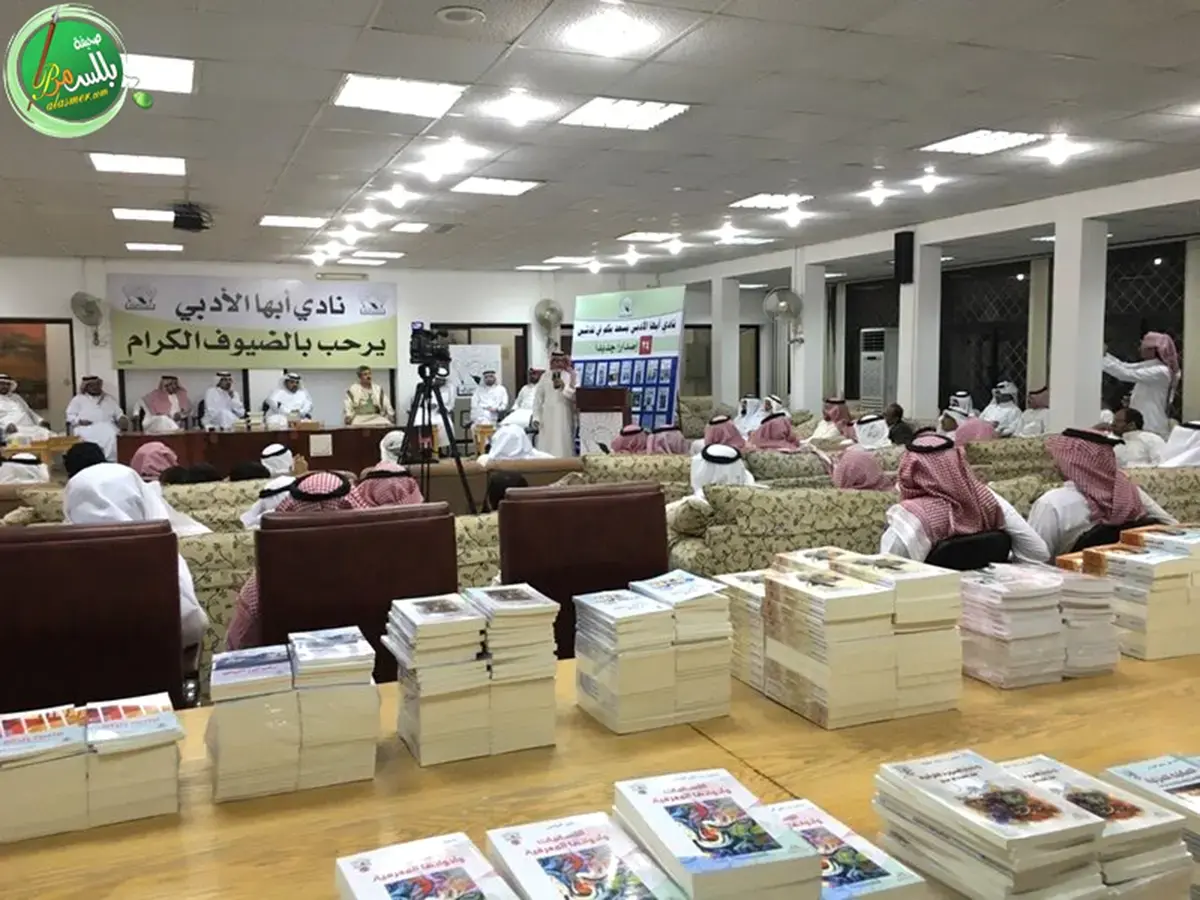
His Royal Highness Prince Faisal bin Khalid bin Abdulaziz, Prince of Asir Region, sponsored the Abha Literary Club’s celebration on the occasion of the 40th anniversary of its founding, and the opening of the second session of its annual conference (Identity and Literature). A number of distinguished personalities were honored in several fields, as His Excellency Dr.

Ismail bin Muhammad Al-Bishri will be honored

51

Ismail bin Muhammad Al-Bishri will be honored for his efforts in the field of historical scientific research and higher education administration, and the storyteller Turki Al-Asiri will be honored in the field of narrative writing, and Ahmed bin Ali Mani’ will be honored in the aspect of poetic creativity.

His Highness honored the heads of the

52

His Highness honored the heads of the Abha Literary Club, who assumed leadership of the club during the past forty years, and contributed through their efforts and those of their colleagues to the prestigious position it has reached at the level of literary clubs in the Kingdom, in addition to honoring Abdulaziz bin Saeed Mushait and Mohammed bin Nasser bin Jar Allah for their support of the club’s cultural programmes.

His Highness inaugurated a project to document

53

His Highness inaugurated a project to document the club’s photographic memory over a period of 4 decades from (1398 AH - 1438 AH), which included more than (15,000 photographs).

On the sidelines of the occasion, the

54

On the sidelines of the occasion, the club launched 5 important publications in the region’s history, geography, and cultural movement, which are the book “A Collection of the History of Asir” by the historian Hassan Al-Hafzi, “The Habasha Market” by the researcher Saad Al-Mady, and the book “Cultural Committees in the Asir Region,” which monitors the experience of establishing cultural committees affiliated with the club in the Asir

Region, and the book “Al-Mutanabbi Culture” by the late writer Ali Al Omar Asir, who was one of the founding members of

the club, and the book “The Record

55

the club, and the book “The Record of the First Conference, Identity and Literature, in its two parts, which includes the scientific papers that were presented in the first edition of the conference in 1436 AH.”

The first newspaper in Asir about a century ago: “Al-Asir” newspaper

The cultural and media movement in the

56

The cultural and media movement in the Asir Region was not new as one might think, but rather an extension of a long history of awareness, knowledge, and individual initiatives that contributed to shaping the features of the cultural community in the south of the Kingdom. More than a century ago, a pioneering journalistic experience emerged in Asir, considered one of the first local media attempts.

It was represented by the issuance of

57

It was represented by the issuance of the first newspaper bearing the name “Al-Asir,” which was founded by the Asir pioneer Saeed bin Muhammad Al-Ghamaz Al-Obaidi Al-Qahtani, to be an early witness to the vitality of thought and the depth of the cultural presence in the region.

6 Al-Ghamaz was born in the city of Abha in 1318 AH, and grew up in an authentic scientific and cultural environment, as his family’s origins go back to the Al Abbas village in Sarat Abidah before moving to Abha, the city that embraced his upbringing and early beginnings.

Al Ghamaz descends from the Al Saqr

58

Al Ghamaz descends from the Al Saqr tribe, from Ubaida Qahtan, a tribe known at the time for its excellence in the fields of artistic creativity, especially the arts of Arabic calligraphy and plastic drawing. Teachers and pioneers also emerged from it who contributed to building generations, by discovering talents, refining them, and developing their abilities, which formed the intellectual environment that influenced Al Ghamaz’s personality and inclinations.

He began his educational career early.

He joined primary school in 1322 AH

59

He joined primary school in 1322 AH, then continued his education in Al-Rashidiya School in 1327 AH, before moving to the preparatory stage in 1331 AH, to complete his academic qualification early in his life.

After graduating in 1334 AH, he entered into practical life, moving between a number of government jobs that gave him extensive administrative experience, where he worked as district clerk in the Abha Finance Department, then as treasurer of the Rijal Almaa Finance Trust, before progressing to multiple positions in Abha, Mahayil, Taif, and Jazan.

He also served as secretary to the

60

He also served as secretary to the delegate of King Abdulaziz bin Abdulrahman Al Saud, which reflects the state’s confidence in his competence and ability. His administrative contributions continued until he was appointed Director General of the Ministry of Agriculture branch in Abha, then Head of the Agricultural Unit, until he was retired in 1380 AH, after a career full of giving.

However, the most prominent aspect of Al-Ghamaz’s

61

However, the most prominent aspect of Al-Ghamaz’s life, which immortalized his name in Asir’s cultural memory, was his early journalistic initiative, when he published the first newspaper in the region when he was in his twenties. This step came at a time when publishing methods were limited, so he chose to have the newspaper handwritten, and called it “Al-Asir,” a clear indication of its connection to place and identity.

It was published weekly from the city

62

It was published weekly from the city of Abha, and addressed community issues, news and public morals, in a conscious attempt to build a local cultural discourse. The first issue of this newspaper was published on Monday, 10/28/1342 AH, and was only three pages long, but it contained rich and varied content.

It dealt with topics related to trade in Asir, and presented awareness-raising articles of a moral nature, the most prominent of which was an article entitled “Do good and you will be rewarded” (resulted in the local form: “Twarjun”).

It also included a group of news

63

It also included a group of news and observations that Al-Ghamaz used to pick up on the radio, which reflects his awareness of the importance of keeping up with the outside world and conveying its news to the local community.

The newspaper was not devoid of creative touches, as Al-Ghamaz added commercial advertisements to it that reflected the economic activity in the region, in addition to hand drawings and schematic maps of the city of Abha, giving it a distinctive visual character that combined information and art.

Thus, “Al Asir” newspaper was not just

64

Thus, “Al Asir” newspaper was not just written papers, but rather a pioneering experience that embodied the beginning of media awareness in the region, and contributed to moving society from the circle of oral reception to the space of blogging and documentation, to remain a living witness to an important stage in Asir’s cultural and media history.

Asir writers and the art of the story

65

Asir writers and the art of the story: the second generation The first generation of artistic story writers appeared in the Asir Region after the year 1390 AH, and the second after Professor Muhammad Al-Hamid, and they are: Muhammad Ali Alwan, Turki Muhammad Al-Asiri, and Dr. Hassan Muhammad Al-Naami.

Muhammad Alwan was the first of them to publish in the press, and to print a collection of short stories entitled: “Bread and Silence”, which was published in the year 1397 AH, and its introduction was written by the Egyptian writer Yahya.

Haqqi, who did not know the writer

66

Haqqi, who did not know the writer personally, gave this collection the attention of researchers in the Saudi story over the following years. It was one of the collections relied upon by the first scholars of the Saudi story, such as: Dr. Mansour Al Hazmi in his book: “The Art of the Story in Modern Saudi Literature,” and Dr. Nasr Muhammad Abbas in his study of the artistic structure in the Saudi story.

Interest in it continued in many local

67

Interest in it continued in many local and Arab studies concerned with the impact of Place in art, as the impact of the Asir environment was apparent to Alwan in this collection, and in his two subsequent collections, and it continued with him in his collection that was published in the year 1419 AH entitled: “Damsa”, which Mamdouh Al-Qadiri described by saying: “Professor Muhammad

Alwan’s short story collection consists of ten stories that revolve around reality, and deeply in the local environment in which he cared and in the lives of people in the

society in which he lives and between

68

society in which he lives and between Dharani, so he mentioned the mountains, the valleys, the oven, the market, drinking tea, the fire of the oven, and the taste of honey,” while the writer Yahya Haqqi did not pay attention to this in his introduction to the collection.

As for Turki Al-Asir, he did not

69

As for Turki Al-Asir, he did not publish his short story writings in the year 1397 AH in Al-Jazeera newspaper, and he did not publish his short story collection: “From the Leaves of the Confidence” until the year 1410 AH. It is distinguished by its boldness in dealing with some topics, such as: social class in the story: “Bereavement”, and love in the story: “Sharifa Al-Ahwal Escapes”, which differs from others in its techniques as a result of the heroine’s escape.

While Muhammad Alwan and Turki Al-Asiri have

70

While Muhammad Alwan and Turki Al-Asiri have received some attention from researchers due to their leadership and creativity in the art of storytelling, the third of this generation, Dr. Hassan Muhammad Al-Naami, has received similar attention because he was able to multiply the reasons for his connection to this art by balancing between two aspects: the practice of writing the story as a storyteller, and studying it as a specialized researcher. In fact, Dr.

Hassan Al-Naami was able to He achieves

71

Hassan Al-Naami was able to He achieves the precise balance between story writing and critical practice and between Arab heritage culture and Western culture and its achievements of modern literary theories and his assimilation of them.” He is later - chronologically - than Turki Al-Asir in the date of the start of story writing, as he did not write them until the year 1399

AH, but he preceded him in issuing short story collections by about six years, as his collection: “The Time of Loud Love” was published in the year 1404 AH, and it includes ten

Stories in which he - such as

72

Stories in which he - such as Muhammad Alwan and Turki Al-Asir - draws inspiration from the local environment in Asir, and the transformations that have occurred in it, and this is evident in the stories: “The Time of Loud Love,” “Chapters from a Journey of Weariness,” and “Revealing the Secrets of Melancholy,” in which he relies on an Asir popular legend about the doors of livelihood, so that his style continues in his second collection: “The Last Comings of

Interpretation.” Al-Qarawi,” which was published in the year 1407 AH, is decorated with poetic

language, but it does not stray from

73

language, but it does not stray from its environment even in the titles of the stories, and the story becomes an expression of an issue in his third collection: “A Dune Occurred,” which was published in the year 1420 AH.

The reviewer concludes that the elements of

74

The reviewer concludes that the elements of the local environment are almost a common theme among the second generation of story writers in Asir, and that these three played an important role in shaping the features of the Saudi story over more than a quarter of a century.

Category: عسير
Previous Back to index Next